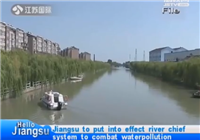
East China’s Jiangsu province will put into effect the river chief system across the province on January 1st next year to combat water pollution. The river chief system requires officials at every level of government to take full responsibility for the protection of rivers and lakes in regions under their jurisdiction.
Heads of the government at the provincial, prefectural city, county or county level district and township levels will be appointed general river chiefs, according to the regulation on river course management released by the provincial government recently.
The river chief system, a new scheme under which local government officers are named river chiefs and take responsibility for dealing with water pollution, has already improved the quality of China's waterways. In Zhejiang Province, black and stink water has been basically eliminated.
Jiangsu Province has announced 36 plans to increase lake coverage by more than 425 square kilometers. The ecological environment of the rivers and lakes in Jiangsu have undergone significant changes with99.1% of the province's water sources measuring up to the standards. By returning the dikes to water bodies, 92 square kilometers of water areas have been reclaimed. Since 2016, more than 150 black and stink water bodies have been cleaned.
The river chief system was an important agenda item in the 2017 government work report, and has become a focus of public attention in China.
River chiefs are tasked with resource protection, pollution prevention and control, and ecological restoration and they will be held accountable for environmental damage in bodies of water under their supervision.
At a meeting on Dec. 8, the Political Bureau of the Communist Party of China Central Committee vowed to make solid progress in 2018 in curbing major risks, eradicating poverty and pollution control, "three tough battles" the country must win to build a moderately prosperous society in all respects by 2020.
China firstly appointed local government officials as river chiefs in 2007 to address pollution woes of a blue algae outbreak in Taihu Lake, Jiangsu Province.
The practice was later adopted in several regions rich in water resources to ensure strong enforcement of environmental policies and enhance coordination.
Government officials will be hired as river chiefs at provincial, city, county and township levels, and heads of provincial regions will be general chiefs that are responsible for all rivers and lakes in the region, according to the document.
For large rivers and lakes that span across regions, river chiefs will be responsible for different parts of the water bodies and cooperate on management.
Responsibilities of the river chiefs include water resource protection, pollution prevention and control, and ecological restoration. The river chief system is linked to the performance evaluations of top officials whose job performance will be assessed and they will be held accountable if environmental damage occurs in the water bodies they take charge of, said the document.
Information including names and responsibilities of the river chiefs will be made public to ensure public supervision, it said.