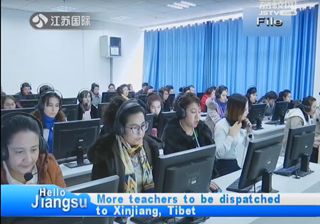
About 1,500 teachers from inland provinces are currently working in Xinjiang and Tibet and another batch of 4,000 teachers will be selected and sent to the regions early next year, according to plan released recently by the ministry of education, the national development and reform commission, the ministry of human resources and social security and the ministry of finance.
The teachers will also be working in the Xinjiang Production and Construction Corps, a unique economic and paramilitary organization in the Xinjiang Uyghur Autonomous Region of the China. The XPCC has administrative authority over several medium-sized cities as well as settlements and farms in Xinjiang. It has its own administrative structure, fulfilling governmental functions such as healthcare and education for areas under its jurisdiction.
China has made huge efforts to improve education in Xinjiang and Tibet during the past decades, including sending teachers to the region to boost bilingual education. In Xinjiang alone, 78 percent of students in primary and middle schools receive bilingual education with the support from teachers from other provinces and municipalities.
China's decision to dispatch a total of 10,000 teachers to the Xinjiang and Tibet autonomous regions to support local education could help solve the educational problems and improve local education in the regions, experts said.
Unlike other remote areas in China that require education support, Xinjiang and Tibet seem to be more challenging for those education volunteers due to its unique geographical conditions.
Many cities in Tibet have an average elevation of 4,000 meters and many newcomers easily suffer from altitude sickness.
Concerning the difficulties, many regions have promised preferential treatment to such volunteer teachers, such as priorities in promotions and higher salaries.