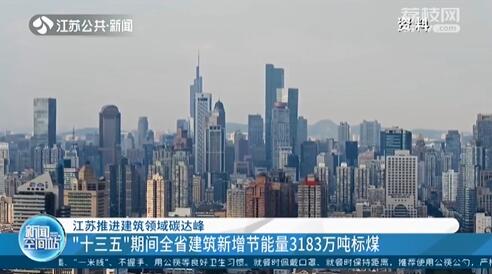
East China’s Jiangsu province continued to practice the concept of green development and promoted carbon peak emission in the construction sector during the "13th Five-Year Plan" period with the province’s newly-added energy-saving buildings hitting 31.83 million tons of standard coal.
During the "Thirteenth Five-Year Plan" period, new buildings in Jiangsu were more energy-efficient with the energy-saving standard increasing from 65% to 75%.
The province added 860 million square meters of energy-saving buildings with the total number of energy-saving buildings reaching 2.3 billion square meters, accounting for 63.3% of the total existing buildings in cities and towns. The scale of energy-saving buildings continued to remain the largest in the country.
Jiangsu increased the application of solar thermal buildings in the proportion of new buildings from 30% to 47.1%.
At the same time, Jiangsu also completed 44.09 million square meters of energy-saving renovation of existing buildings.
According to estimates, during the "13th Five-Year Plan" period, the province's new building energy savings reached 31.83 million tons of standard coal, which is equivalent to reducing carbon dioxide emissions by 82.75 million tons.
During the 14th Five-Year Plan period, Jiangsu will actively carry out energy efficiency improvement actions for existing public buildings, focusing on high-energy-consuming buildings in categories such as hospitals, hotels, shopping malls, and transportation stations, and promote green and energy-saving renovation.
At the same time, Jiangsu will actively carry out pilot demonstrations of ultra-low-energy buildings, near-zero-energy buildings, and zero-energy buildings in a bid to promote the achievement of carbon peak emission in the construction sector.