East China’s Jiangsu province has given full play to deepening the grid-based social governance mechanism, exploring the formation of a governance mechanism featuring big data, grid and iron sole so as to contribute Jiangsu’s wisdom to the new pattern of co-governance and shared grassroots social governance.
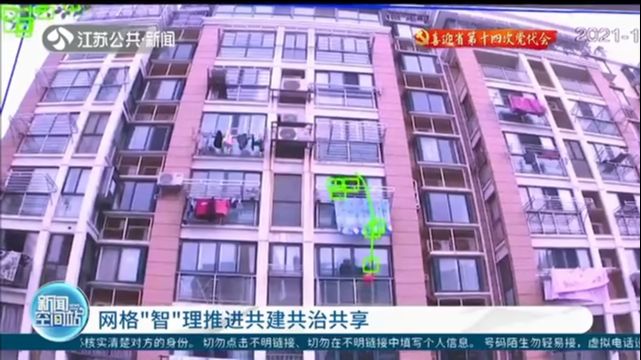
Kan Tianfeng, a grid worker in Nantong, was recently told that a small amount of rubbish was discarded on the road of a community he was in charge of.
Arriving at the site, Kan Tianfeng delivered an online report to the Chongchuan District Regional Governance Modernization Command Center.
Assisted by the police, Kan screened the video surveillance of the high-altitude garbage disposal monitoring system and soon determined that a resident on the 5th floor dumped the garbage.
Kan Tianfeng, Grid Worker in Nantong
This system can accurately trace the source
to the specific buildings
and specific households
where the garbage is discarded
so that we have a pertinence
in the post-processing
Li Chunlin, Secretary and Director of the Community Party Committee of a community in Nantong
Now with the help of
the regional governance modernization
command center platform
we have formed a rapid response mechanism
through cooperation with the police
Chongchuan District of Nantong City has built a regional governance modern command center. Social governance grid workers can rely on big data to accurately share grassroots governance affairs and greatly improve the efficiency.
Wang Qiang, Deputy Secretary of the Political and Legal Committee of Chongchuan District Committee, Nantong City
Through whistle-blowing of grid workers
and intervention by government departments
we can simplify the process of formalities
reduce the time spent on handling affairs
and ensure that we respond
to the people's demands
in a timely and effective manner
Modern scientific and technological means have added "wisdom wings" to grassroots social governance, ensuring that management units are minimized and service efficiency maximized.
The roof of a residential area in Nanjing is leaking, and the public maintenance fund must be used to repair the roof. In the past, community workers had to knock on doors from house to house to solicit opinions, but now residents only need to move their fingers to vote for confirmation in real time. The introduction of block chain technology allows the use of funds to be supervised throughout the process.
Wu Guangjuan, Resident of Nanjing
All information is open and transparent
In the past
we had to wait for a long time
to complete the consultation
but now it can be completed in one week
Xu Cailian, Head of Citizen Appeals Processing Center of a Sub-district Office in Nanjing
The non-tamperable feature of block chain data
has established a trusted data platform
for all parties
played the role of supervision and regulation
helped resolve conflicts at the grassroots level
and established mutual trust in social governance
In recent years, Jiangsu has gradually established a social governance chain covering the prefecture, county and township levels from the comprehensive governance center, the grid-based service management center to the social governance modern command center.
Nearly 300 thousand full-time and part-time grid workers are distributed in 120 thousand urban and rural grids in the province, with an average daily report of more than 60 thousand pieces of data. 90% of latent safety hazards and disputes can be dealt with and resolved within the grid.
In the first half of this year, 99.21% of the people in the province increased their sense of security, and 97.99% were satisfied with grid service management.
All 13 prefecture-level cities in Jiangsu have been included in the national pilot program for social governance modernization.