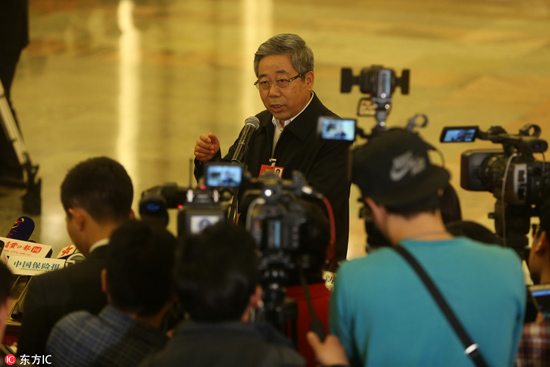
Minister of Education Chen Baosheng. [Photo/IC]
Chinese parents, especially those living in big and medium-sized cities are facing difficulties taking care of their children after 3:30 pm, which is generally when schools end for the day, since they are still at work.
The phenomenon is nicknamed, despite the parents’ intentions, as a “3:30 pm issue”.
Since February 2017, the country’s Ministry of Education has attached importance to the phenomenon, with 25 provincial-level regions having taken steps to guide local schools and communities to work together in tackling the problem.
Minister of Education Chen Baosheng spoke highly of the measures taken by Jiangsu province on March 3, on the sidelines of the ongoing session of the 13th National Committee of the Chinese People’s Political Consultative Conference.
The flexible school time program mentioned by the minister has been fully implemented in more than 350 primary schools in the provincial capital of Nanjing since Feb 20, 2017. Nearly 72,000 students currently participate in the scheme, accounting for 18.4 percent of the total.
The scheme allows students to delay their time of departure to 5 pm during the winter semester (from Nov 1 to March 31 the following year) and 6 pm for the other semesters.
“Parents have made quite high remarks, as at a recent survey of 10,000 local residents, 98.8 percent of them have voiced support for the program,” said Ge Daokai, director-general of the Jiangsu Provincial Department of Education.
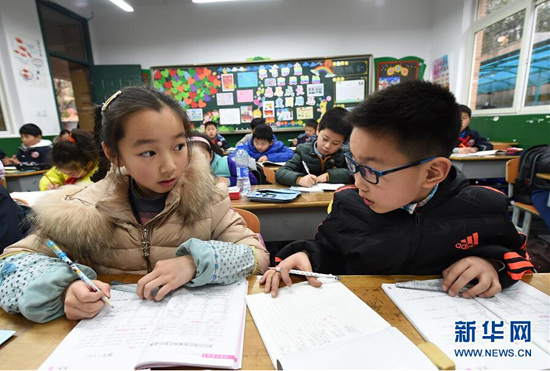
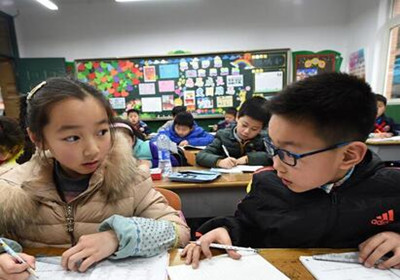
Students in the flexible school day scheme do homework together. [Photo/Xinhua]
Huangfu Litong, an experienced high school teacher from northern Jiangsu, said the scheme has led to some new problems, particularly the students’ safety problems, as well as those concerning the diversity of after-school activities and the added cost for teachers.
Tang Jiangpeng, principal of the Jiangsu Xishan Senior High School, shared his idea as the after-school services should focus from helping students finish their homework to encouraging them engage in various cultural and sports activities.
Minister of Education Chen Baosheng also took Beijing, Shanghai and Guangxi as examples.
Shanghai’s local authority required all its middle and primary schools to provide after-school services from 3:30 to 5 pm. Beijing provides subsidies of 700 yuan ($110) to 900 yuan per year for each student, from 3 to 5 pm, mainly for after-school activities. Guangxi has sought help from surrounding communities.
“We will discuss this with related departments and work together in solving the problems,” Chen said.