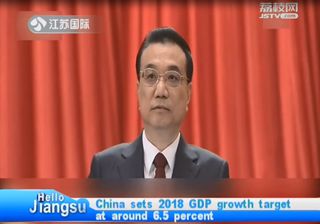
China’s GDP grew from 54 trillion to 82.7 trillion yuan in the past five years, registering an average annual growth of 7.1 percent, said Premier Li Keqiang while reviewing the government’s work at the opening meeting of the first session of the 13th National People's Congress on Monday.
The 13th National People's Congress, China's national legislature, opened its first session Monday morning at the Great Hall of the People in Beijing.
Xi Jinping and other Chinese leaders attended the opening meeting, at which Premier Li Keqiang delivered a government work report.
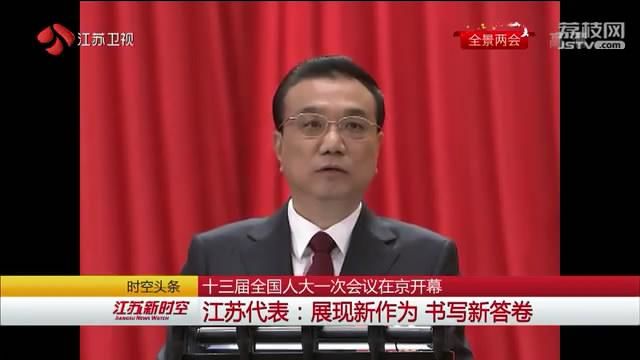
For 2018, the 40th anniversary of the reform and opening up policy, China has set an economic growth target of around 6.5 percent, Chinese Premier Li Keqiang said on Monday.
Li announced the target in the annual government work report during the opening meeting of the first session of the 13th NPC.
The world’s second-largest economy achieved economic growth of 6.9 percent in 2017, surpassing its GDP target of around 6.5 percent amid tightening regulations aimed at combating financial risk. 2017 saw economic growth accelerate for the first time since 2010.
In addition to China’s GDP target, Premier Li also said that the growth target for China’s CPI or consumer price index would be set at around three percent.
China plans to create over 11 million new urban jobs, keeping surveyed urban unemployment within 5.5 percent, with the registered urban jobless rate to be kept within a range of 4.5 percent.
This year is the first time that China has used “surveyed urban unemployment” as a projected target, intending to give a fuller picture of employment. The surveyed urban unemployment rate covers rural migrant workers and other permanent urban residents.
China will also look to achieve a steady rise in import and export volumes, while also reaching a basic equilibrium in the balance of payments.
As the country strives to fight three critical battles against potential risk, poverty and pollution, China expects to make substantial progress in its ongoing supply-side structural reform. Premier Li said the country would look to basically achieve stable macro leveraging, while systematically and effectively preventing and controlling risk.
Prudent monetary policy will remain neutral, with easing or tightening measures only to be applied where appropriate.
Meanwhile, China plans to reduce energy consumption per unit of GDP by at least 3 percent, while continuing to reduce emissions of major pollutants.
Li said China would look to improve the structure of its budgetary spending, ensuring that more financing would be allocated for the public good.
More financial support will be offered to help the three critical battles against potential risks, poverty, and pollution, while Li added spending will be more weighted towards innovation-driven development, the agricultural sector, rural areas and rural residents, as well as improving living standards.
(Source:Jiangsu International Channel)