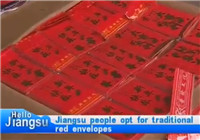
Traditional paper-based red envelopes or hongbao are being sold like hot cakes in Jiangsu due to the sense of New Year celebration and human touch as the spring festival is drawing near.
Traditional paper-based red envelopes are being shelved at conspicuous places at many supermarkets in Xuzhou. The envelopes or hongbao are printed on the cover with blessings wishing people good fortune and success in the New Year.
In the wholesale markets, traditional paper-based red envelopes are also gaining popularity, a striking contract to the prevalence of the digital hongbao in the past years.
China’s largest e-commerce company Alibaba, put its own spin on the custom by handing out virtual red envelopes with cash or gift coupons during the Spring Festival Gala, a popular annual show that airs the evening before Chinese New Year starts. In 2015, Alibaba saw its WeChat deliver over one billion red envelopes during the spring festival.
Many people, especially, the elders, say they prefer paper-based red envelopes plus banknotes when giving hongbao to the kids.
Getting a fat hongbao, or red envelope, stuffed with crisp new notes is one of the hallmarks of the Chinese New Year.
Red envelopes always contain money in China, and are given, most commonly, to kids from their parents, grandparents, and others as Chinese New Year gifts.
In China, the red envelope is called yasui qian, which means 'suppressing ghosts money'. Those who receive a red envelope are wished another safe and peaceful year.
Actually, the significance of red envelopes is the red paper, not the money inside. Wrapping money in red envelopes is expected to bestow more happiness and blessings on the receivers. Hence, it is impolite to open a red envelope in front of the person who gives it to you.
Red envelopes can also be given to unmarried adults, elderly relatives, friends, and employees during celebrations and on special occasions.
(Source:Jiangsu International Channel)