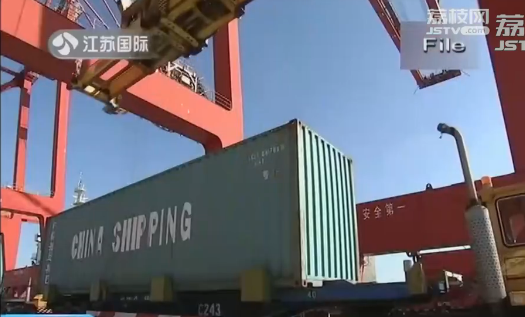
China's global trade volume reached 13.14 trillion yuan (1.95 trillion US dollars) in the first half of 2017, an increase of 19.6 percent, Qian Keming, China's vice minister of commerce announced Monday.
"The global economy is seeing an accelerated growth, and global trade is also picking up speed. The outer environment of China's trade development has improved," Qian said at a press conference at the State Council Information Office.
Exports in the first half of the year climbed 15 percent from a year ago, while imports increased by 25.6 percent year on year.
Qian also said that China's overseas investments had become more reasonable with foreign direct investment in the first six months of 2017 decreasing by 42.9 percent year-on-year to 331.1 billion yuan.
Exports in yuan-denominated terms rose 15 percent year on year in the first half of this year while imports increased 25.7 percent, customs data showed on July 13.
That led to a trade surplus of 1.28 trillion yuan in the same period, down 17.7 percent year on year, according to the General Administration of Customs.
Total foreign trade volume reached 13.14 trillion yuan H1, up 19.6 percent year on year, the quickest pace since the second half of 2011.
The brisk growth was bolstered by a lower comparison basis, government support and healing global demand, Huang Songping, a spokesperson with the customs authority, told a press briefing.
During the first six months, trade with the EU jumped 17.4 percent from the same period last year.
Meanwhile, trade with the United States and ASEAN went up by 21.3 percent and 21.9 percent, respectively.
Private businesses played an important role in foreign trade with exports and imports value up 20.6 percent to 5.02 trillion yuan in the first half, or 38.2 percent of the nation's total.
Most of China's exports were mechanical and electrical products and labor-intensive products.
Huang brought attention to a tough stance on foreign trade in the second half of this year due to a higher comparison basis, uncertainties in the global environment and deep-seated problems in the domestic economy.
Uncertainties weigh on the global market as major economies practice divergent monetary policy. Commodity prices and trade protectionism also add unpredictability.
As developed economies shore up advanced manufacturing and emerging economies strengthened on low-end manufacturing, China's exports are due to face more fierce competition in the global market.
But the strong fundamentals of China’s foreign trade have not changed. They will continue with such good momentum, and the trade structure will be improved if no major risks are brought about, Huang said.