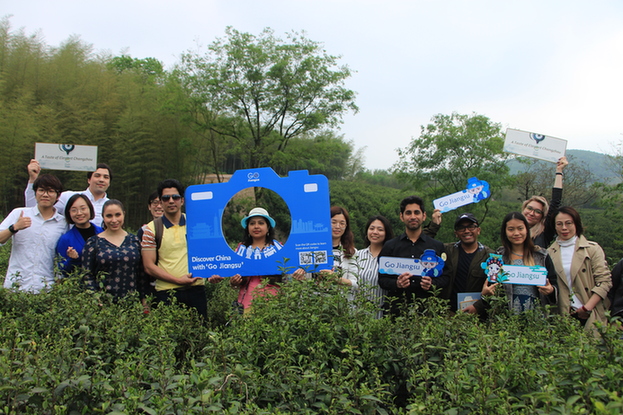
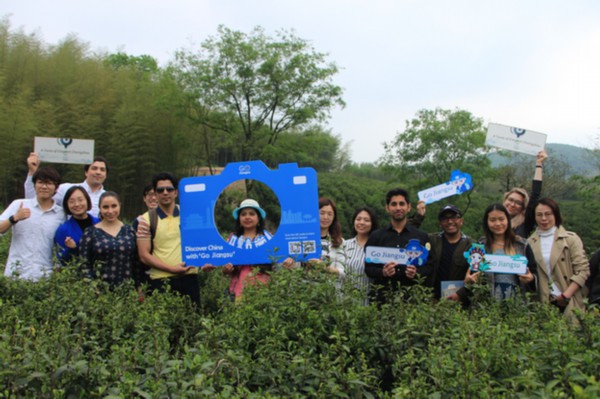
Expats pose for a group photo at a tea garden in Changzhou on April 20. [Photo by Xiao Da/chinadaily.com.cn]
As gardeners smiled and basked in the questions from tourists as they showed them how to harvest Queshe tea leaves in Jintan district, Changzhou on April 20, a group of expats joined them to explore local tea culture on the very special day that also marked Gu Yu, the last solar term of spring, which can also be translated to Grain Rain.
The group of 10 expats participated in the opening ceremony for the Go Jiangsu: Enjoy Spring Tea and Coffee in Elegant Changzhou event and learned how tea leaves are picked and the process of making Jintan Queshe Tea.
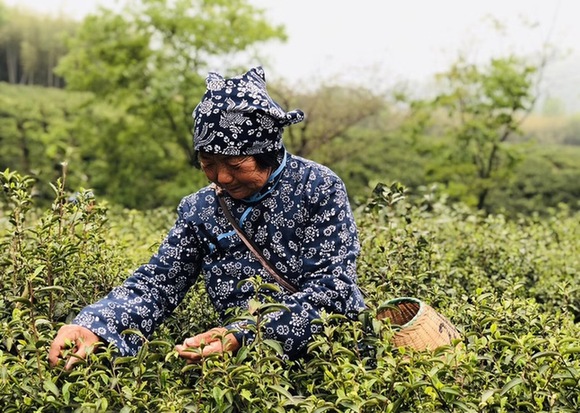
Locals harvest Queshe tea on April 20, which marks Gu Yu, also known as Grain Rain, which is the last solar term of the spring in the Chinese lunar calendar. [Photo provided to chinadaily.com.cn]
It was not until siting down to have a taste of the Queshe tea that they noticed the uniqueness of this specialty of Jintan.
“I’ve tasted different kinds of green tea in China, but it was the first time I see the leaves stand erect in the boiled water neatly this way,” said Kolosova Antonina, from Russia.
Queshe tea has a distinct appearance when dried, resembling a sparrow’s tongue, and can stand like a bamboo shoot in water for several hours.
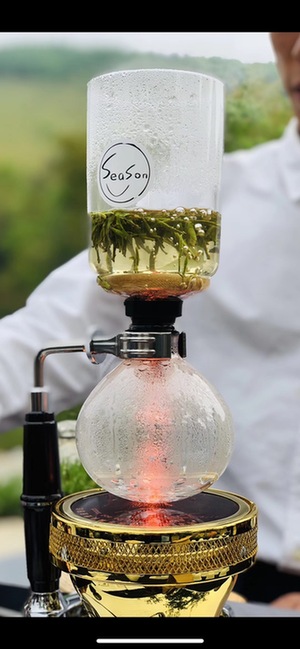
A barista extracts Queshe tea using a Siphon coffee maker in Changzhou on April 20. [Photo provided to chinadaily.com.cn]
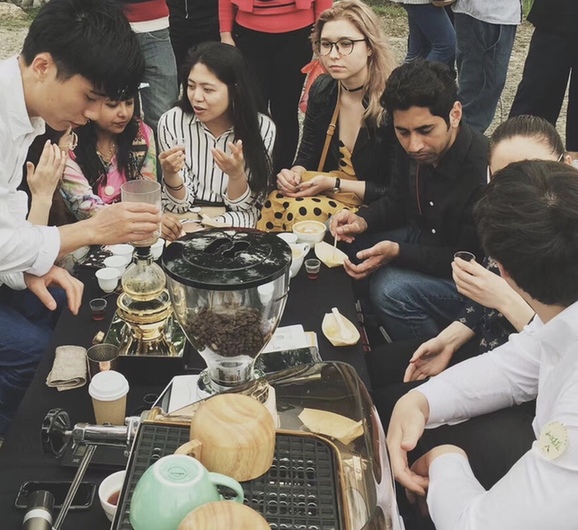
Expats have a discussion on the different drink cultures of tea and coffee in Changzhou on April 23. [Photo provided to chinadaily.com.cn]
As baristas from Season Coffee displayed how they made different kinds of coffee on site, the expats also enjoyed coffee and had a discussion on the two different drink cultures.
“I prefer coffee over tea as a habit, but I love the scent of tea. Tea is much more healthy, it’s just I prefer the stronger taste of coffee,” Antonina said.
According to Muhammand Aulia Rahman, from India, every detail of the tea ceremony was fascinating to him: “I learned how to make a tea and how to serve it. The tea must be served for 70 percent of the glass.”
Dennis Brian Hartmann Moestrup, from Denmark, said that Danes mostly prefer to use teabags and believed that “be it a cup of tea or coffee, what matters most is that we enjoy life.”
While in high school, Dennis completed an assignment on the porcelain tower in Nanjing, which sparked his curiosity about Jiangsu province. Later at university, he did an assignment on John Rabe, the Good Shepherd of Nanjing, which he said gave him a lot to think about. Dennis expressed his excitement to experience some of the local culture in Jiangsu during the Go Jiangsu trip in Changzhou.
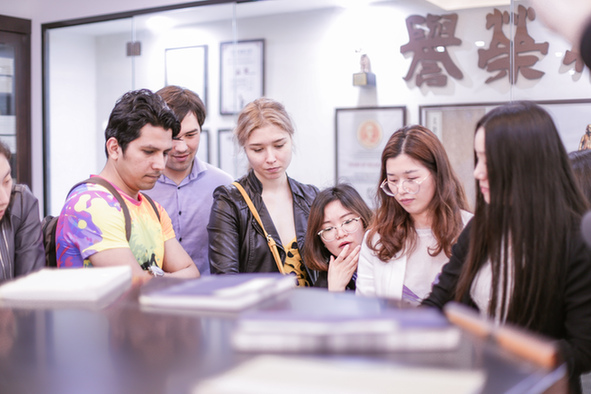
Expats get to know the characteristics of ancient printing at Jintan Ancient Books Printing Factory on April 21. [Photo provided to chinadaily.com.cn]
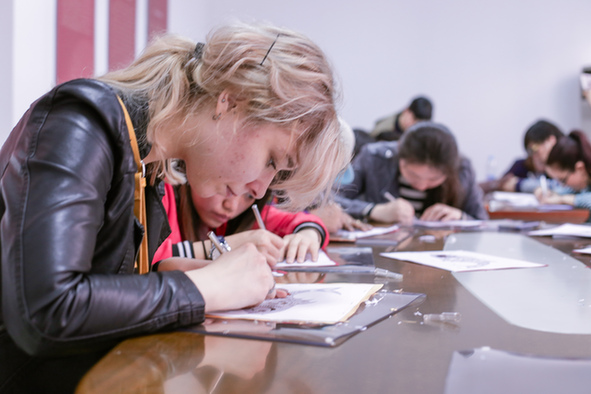
Expats focus on making paper-cuttings of their own under the guidance of Yang Zhaoqun, an inheritor of the intangible cultural heritage, in Changzhou on April 21. [Photo provided to chinadaily.com.cn]
On the second day of the trip, expats visited the Jintan Ancient Books Printing Factory and learned to make their own paper-cuttings at Jintan Paper-cutting Arts Center.
According to Yang Zhaoqun, inheritor of the intangible cultural heritage, Jintan paper-cutting is special in that it uses a specific knife to carve patterns on paper instead of using scissors to cut it out.
“I really enjoyed paper-cutting because of the beautiful results and the relaxing process. It is something I want to share with my family in Mexico because I think they will really like it too,” said Nathalie Nunez Sanchez who has lived in China for eight years. She mentioned that in Mexico, there is a similar folk art called papel picado and people use it to create decoration for holidays, particularly Día de Muertos, also known as Day of the Dead.
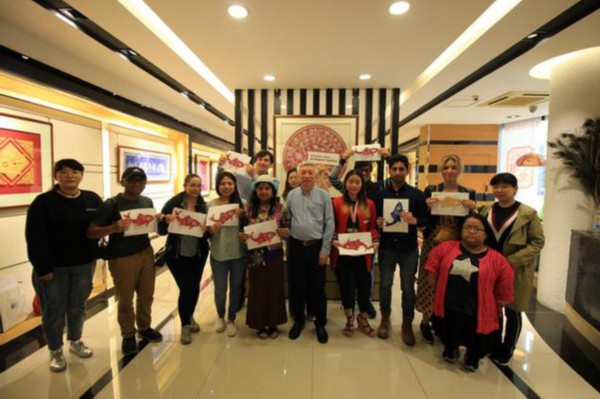
Expats show off their paper-cuttings at Jintan Paper-cutting Arts Center in Changzhou on April 21. [Photo by Xiao Da/chinadaily.com.cn]
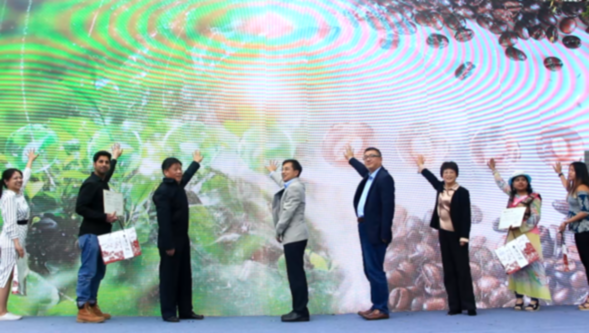
Winners of the “Jiangsu’s Changes in 40 Years” photo contest launch the Go Jiangsu: Enjoy Spring Tea and Coffee in Elegant Changzhou event with officials including China Daily Deputy Editor-in-Chief Wang Hao (fourth from the left) and Yang Liqun, deputy director of the Publicity Department of CPC Jiangsu Provincial Committee (fourth from the right). [Photo by Xiao Da/ chinadaily.com.cn]
Among the expats, five of them were winners of the “Jiangsu’s Changes in 40 Years” photo contest held last year. China marked the 40th anniversary of reform and opening-up in 2018. To celebrate the momentous occasion, the Jiangsu Provincial Information Office and chinadaily.com.cn held a photo competition named “Jiangsu’s Changes in 40 Years,” inviting fans from around the world to share their appreciation for how far Jiangsu has come since reform and opening-up began.
Zhorea Shara from the Philippines loves taking pictures of nature and has visited Nanjing a couple of times, falling in love with the city. “I would love to share the great experience with my country,” said Shara who was very happy about participating in the contest with her boyfriend Mirza Nasir and both of them receiving the first prize award.
Indah from Indonesia lives in Nanjing and has traveled to cities such as Yangzhou, Suzhou, and Hangzhou. She said that China has developed so fast and it’s a vast country with diversified culture. “Winning the first prize makes me very confident. I am so happy to join the Go Jiangsu trip to make new friends and learn more about Chinese culture,” she said.
Husnain Raza, from Pakistan, has been living in Wuxi for more than four years and has visited more than 15 cities in China including Beijing, Shanghai, and Suzhou. For him, the historical architecture and beautiful landscapes in China fortified his skills in photography and he considers the Go Jiangsu trips a great opportunity for him to explore the beautiful scenery and culture of Jiangsu province. “I would love to avail every chance to travel and capture the beautiful world in the eye of my camera,” said the second prize winner.
Muhammand Aulia Rahman, from Indonesia, said his loves are travelling, photography, and editing photos and videos. As a third prize winner attending the award ceremony, he said, “This is really such an honor and the wonderful trip has been unforgettable”.
The Go Jiangsu trip to Changzhou also included visits to Maoshan Mountain, Oriental Salt Lake Resort, and Baosheng Park. Last year, Go Jiangsu trips were held in Nanjing, Wuxi, Suzhou, Yangzhou, and Zhangjiagang. The Changzhou event was the first Go Jiangsu trip of 2019 with more to be announced later in the year.
(Source:chinadaily.com.cn)